
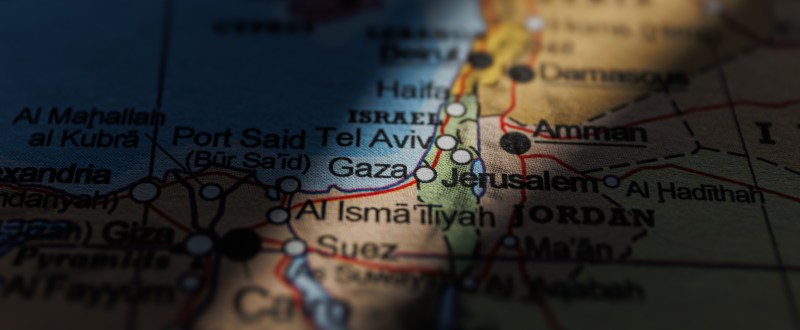

In my search for critical Israeli voices, I have been following David Grossman for some time now, celebrated author and KU Leuven honorary doctor. In his interviews, his gentle voice takes a firm stand against Benjamin Netanyahu. He sees the fact that Netanyahu forms a government with the extremely nationalistic Otzma Yehudit as a direct threat to the future of Israel. With a similar intensity, he condemns the colonists in the occupied territories.
‘I don’t want to occupy anyone, nor do I want to be occupied by anyone,’ he stated a few months ago in a CNN interview. Israel was meant to be a house and a home, but it has become a fortress. As long as the Palestinians don’t have a home, the Israeli won’t have a home. Grossman rightly states that only when the occupation of the Palestinian territories ends, Israel can survive in the Middle East, and the Israeli people can have a life with dignity.
The pain caused by the dehumanising violence in Gaza, the disaster that struck Southern Lebanon, and the fate of the Israeli hostages is unbearable to Grossman. What troubles him is that the leaders on both sides seem unable to recognise the tragedy that the other side is experiencing, not showing a trace of understanding or even just some simple compassion. ‘We must come to understand the suffering of the enemy, to comprehend their pain.’ Emotional words from a father who lost his son in the last hours of the 2006 Israeli–Lebanese war.
I, and many people in our university community, share Grossman’s voice of indignation. There is some indignation too, about KU Leuven’s attitude, for instance because we maintain our policy as stated in a previous blog post after recent decisions made by the International Criminal Court. Our approach indeed sparks different opinions. That is a good thing. Diversity in perspectives contributes to the dynamics of a university.
What does KU Leuven stand for?
A certain neutrality is to be expected of universities and their administration in periods of political turmoil. This is the only way a university can defend itself against accusations of political bias. By maintaining a neutral position, a university can guarantee room for freedom of speech and for uninhibited and unrestrained research. It is exactly this room for freedom of speech that is used by many of our students and staff members to strongly condemn the violence in Gaza and Southern Lebanon.
But when military actions turn into downright acts of terror, absolute neutrality becomes hard to defend. If attacks on civilians and civil infrastructure are clearly a violation of international humanitarian law, a university cannot remain silent. Therefore, the KU Leuven administration has repeatedly called for a cease-fire and condemned the ruthless violence in public statements, in conversations with the Israeli Rectors, and in academic diplomacy contexts.
We have to keep repeating this call: KU Leuven asks Israel to respect the international humanitarian law and to show responsibility and care for the civilians in the occupied territories. Our university also calls for a cease-fire and for a commitment to working towards long-lasting peace between Israel and Palestina.
Now that the International Criminal Court has issued an arrest warrant against Netanyahu, Gallant, and Hamas leader Deif, and wants to prosecute them for war crimes and crimes against humanity, a new political reality is knocking at the door: the European Commission can hardly negotiate admission to the next European Framework Programme for Research with political leaders who are prosecuted by the International Criminal Court. This will be an important topic in consultations at European level.
Caution and consideration in research are key
We condemn the violence in Gaza and Southern Lebanon and share the strong feelings of indignation. At the same time, we do not want to hold individual researchers and their teams accountable for their government’s actions. In addition, we follow an approach that we can apply consistently, independent of which crisis area we are working in: today we are active in the Middle East; in the past, we were active, for instance, in DR Congo, or in Ethiopia, where the Tigray war caused an estimated 150,000 victims.
In previous communications, we have summarised our policy as follows: open, not blind. We repeat the call for caution and consideration for all KU Leuven researchers when considering collaborations with Israeli partners. The Ethics Committee on Dual Use, Military Use and Misuse of Research (EC DMM) continues to carefully screen new collaborations for potential risks of violations of human rights or risks of military use of research results. As a general rule, new collaborations with entities of the Israeli government remain out of the question, and all educational collaborations with Israeli universities have been put on hold. With this policy, KU Leuven sends out a strong message to our partners in and outside Europe.
Over the past couple of months, a limited number of projects has been approved, after thorough screening and discussion by the EC DMM. An equal number of projects was rejected. New projects mainly include doctoral networks where exclusion of KU Leuven participation would hinder young researchers in their doctoral programme, or large consortia in the biomedical context (on rare diseases or mRNA vaccination techniques for cardiovascular conditions) where exclusion of our participation would disconnect us from dozens of other key partners, and would have a negative effect on vulnerable patient groups.
The EC DMM makes its decisions in full independence, based on sound ethical considerations and thorough research. It operates within the framework that was developed in consultation with the university administration. The university administration holds full responsibility of the decisions that were made. Critical voices or actions should be directed to the Rector and the Vice Rectors concerned. We cannot accept direct criticism or personal attacks aimed at the members of the ethical committee.
Showing solidarity
The debate at universities is focused on continuation and approval or rejection of research projects. Sometimes, the debate seems to forget to address what we can do for the affected civilians, and, more generally, for those who flee areas of crisis and violence. The university administration takes the previously articulated commitments seriously. A blog post published on 6 June announced that KU Leuven would significantly increase its support for refugees. This support is in full development and has been given high priority.
There is the Scholars at Risk programme. In addition, KU Leuven is co-founder of the Global University Academy. We have gained experience with the EU Passworld project and have become a partner of the Daughters for Life Foundation, with the goal of annually awarding a number of scholarships to female students from Gaza. We have opened up some doctoral scholarships and accommodation grants for Palestinian refugees. We make additional investments in the Paso programme for young refugees, in Praxis P’s transcultural trauma care programme, and in local trauma care programmes in collaboration with Gaza University. Conversations are currently being held to establish a Global Institute at KU Leuven, supported by the World Health Organization, which will study the origin and effects of hate as a socio-endemic disease. This project will be a collaboration with Izzeldin Abuelaish, Palestinian doctor and author of the book I shall not hate.
A similar sense of caring is important at KU Leuven. Embracing non-violence, starting conversations, promoting connection, fighting against antisemitism and islamophobia: we can’t expect anything less from each other. It will not be a surprise to anyone that in this very complex situation and with the many moral dilemmas at play, there are various different opinions at KU Leuven about what the best approach might be. Show openness to people whose opinions differ from yours, and start a conversation with them. This too, we can expect from each other.
Luc Sels, Rector,
On behalf of the Executive Board
 KU Leuven blogt